
Axle pays £1 per kWh when it dispatches your home battery to support the grid. On my own export tariff that is roughly five times the best half-hour price I saw all day. I signed up at the start of August 2026 to find out whether the headline survives contact with a real system. Two months and eight grid events later, here is the ledger without editing.
Put your battery to work
This is my referral link. Axle pays £25 each to you and me when you join, so going to axle.energy directly costs you that £25. GivEnergy customers are not eligible for referral rewards.

My setup, and why I was sceptical
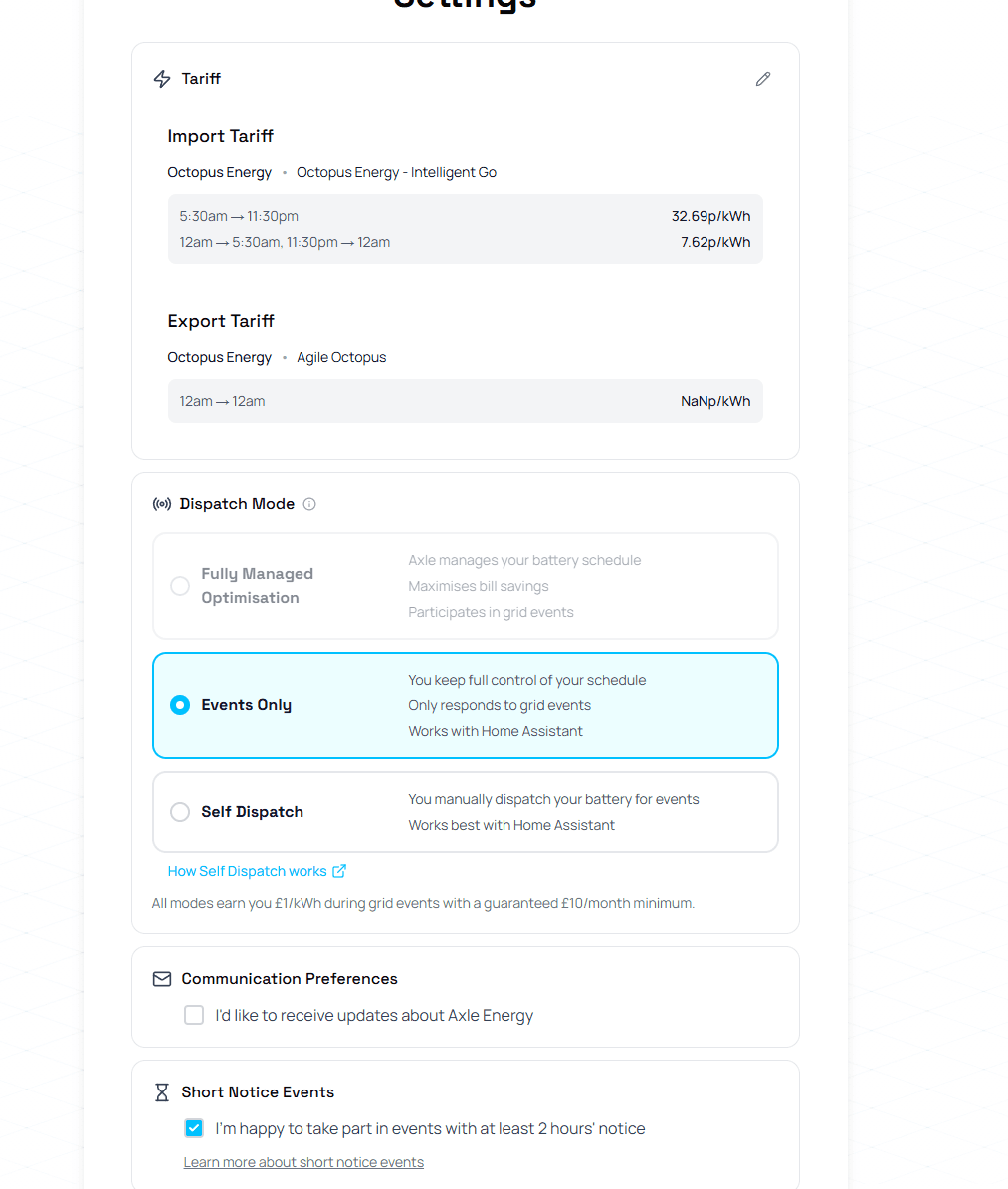
The system is a FoxESS battery and hybrid inverter on a domestic solar array. Import is Octopus Intelligent Go, which means 7.62p per kWh in the overnight window from 11:30pm to 5:30am and 32.69p the rest of the day. Export is Agile Octopus, so the price I am paid for every unit I send out moves every half hour.
The battery is not left to its own devices. It runs on a schedule I build myself in Home Assistant, which is the reason I hesitated before signing up. Handing a slice of control to a third party felt like inviting something to trample a plan I had spent a long time tuning. Two things changed my mind. Axle only takes the battery during a grid event and hands it straight back afterwards, and there is a floor of £10 a month whether events happen or not.
What actually happens during a grid event
A grid event is a short window when the national system is tight and needs more power on the network than it has. Axle asks your battery to export into that window and pays £1 for every kWh it sends. That is the whole product. There is no tariff switch, no change of supplier, and no new hardware.
The dispatch does not go through Home Assistant. Axle talks to the FoxESS cloud and commands the inverter directly. From my side the first sign of an event is usually the battery already exporting at full tilt when my own plan said it should be sitting still.
Events are short and they do not empty the battery. Across eight of them my largest single payment was £8.65, which at £1 per kWh means the battery sent about 8.65 kWh. The average across all eight was closer to 4.7 kWh. Axle's own illustration of a typical day shows the same shape: state of charge climbing overnight, a sharp dip of roughly a quarter of the battery during a morning event, then straight back to your own schedule for the rest of the day.
The £25 sign-up bonus, and my disclosure
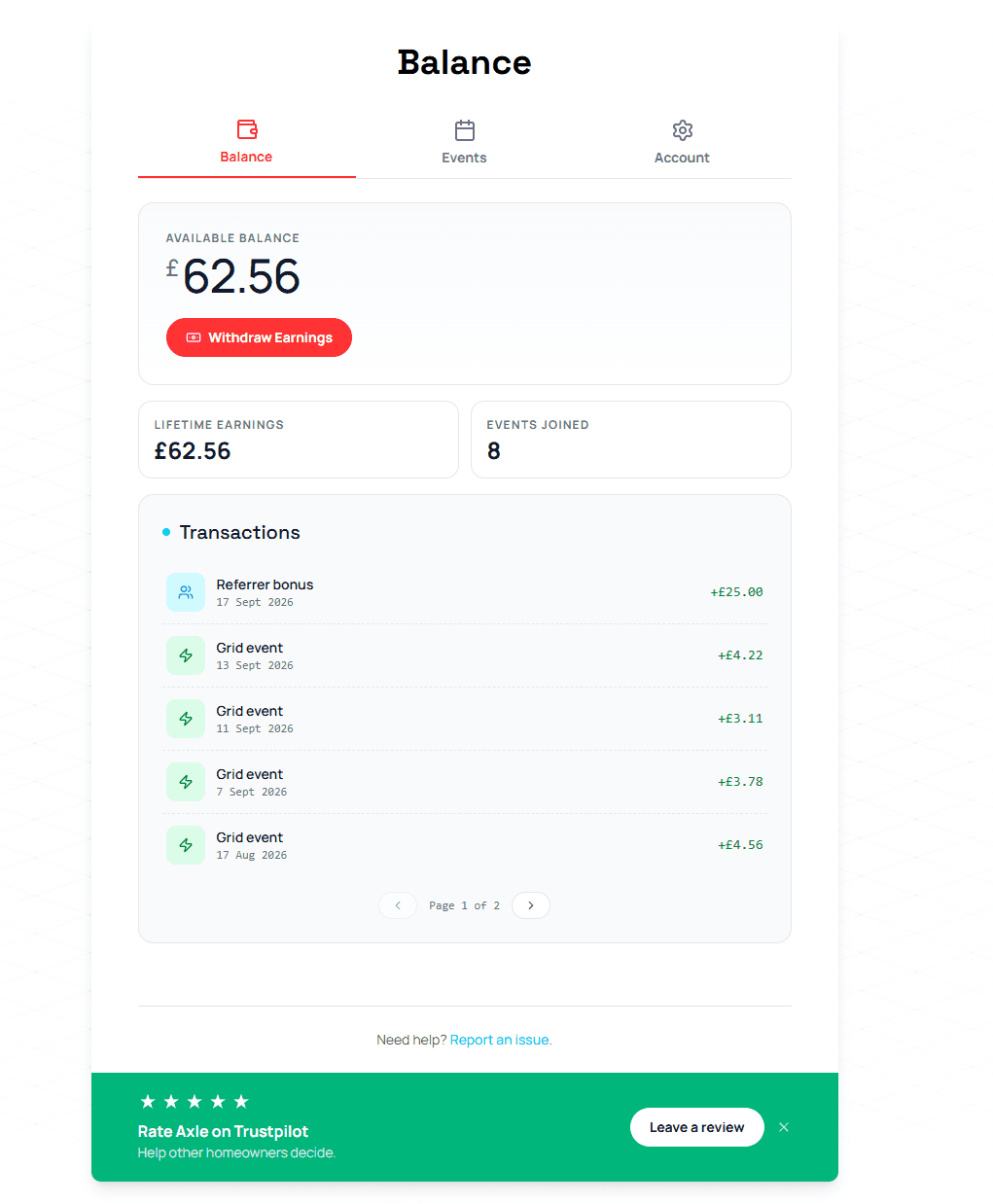
This one goes near the top because it is the part you can only act on before you sign up. Axle's referral terms are £25 each: you get £25 credit and so does the person whose link you used. One person has signed up through mine so far, and that £25 shows up as a transaction dated 17 September in the screenshots further down this page.
That changes how you should sign up. If you go to axle.energy directly you get exactly the same programme, but there is no referral attached, so the £25 on your side simply does not happen. It is the one part of this where reading a review and acting on it is worth real money to you rather than just to me.
There is one exclusion worth knowing before you get your hopes up. GivEnergy customers are not eligible for referral rewards, so if that is your battery, neither side gets the £25. You get the included GivEnergy Premium subscription instead, which is covered further down, but do not join expecting both.
The rest of it means I have a financial interest in you using my link, and you should weigh that against everything else here. Nothing on this page changes because of it. The figures are screenshots of my own account, the events are the events, and if Axle had paid me £3 in two months this guide would say so.
As with the rest of the programme, the £25 is a current beta term rather than a permanent promise. Check it still applies at the point you join.
The three dispatch modes, and which one I picked
This is the setting that decides how much of your battery you hand over, and it is the first thing I would look at. There are three options and you can change between them whenever you like.
Fully Managed Optimisation gives Axle the whole schedule. It runs the battery to maximise your bill savings and joins grid events as they come. If you do not want to think about any of this, that is the one to pick.
Events Only, which is what I run, leaves your schedule entirely alone. Axle touches the battery during a grid event and at no other time. This is the mode for anyone already running their own optimisation in Home Assistant, Predbat or similar, because nothing interferes with the plan you have built except the events you are being paid for.
Self Dispatch goes one step further and hands the event itself back to you. Axle calls the event and you dispatch the battery yourself from your own automation, which suits people who want their scheduler to stay the single thing in charge of the inverter. Predbat can be wired up to do exactly this, and that is a guide of its own rather than a paragraph in this one.
The important line is at the bottom of that settings panel: all three modes earn £1/kWh during grid events with the guaranteed £10 a month minimum. Choosing to keep control does not cost you anything.
One more toggle worth finding on the same screen is Short Notice Events, which opts you in to events called with at least two hours' warning. More events means more earnings, and two hours is plenty for a battery that is already sitting there.
Which batteries and inverters it works with
Compatibility is the thing most likely to stop you before you start. Axle integrates through each manufacturer's cloud rather than through a local connection, so support is brand by brand and the list is growing rather than universal.
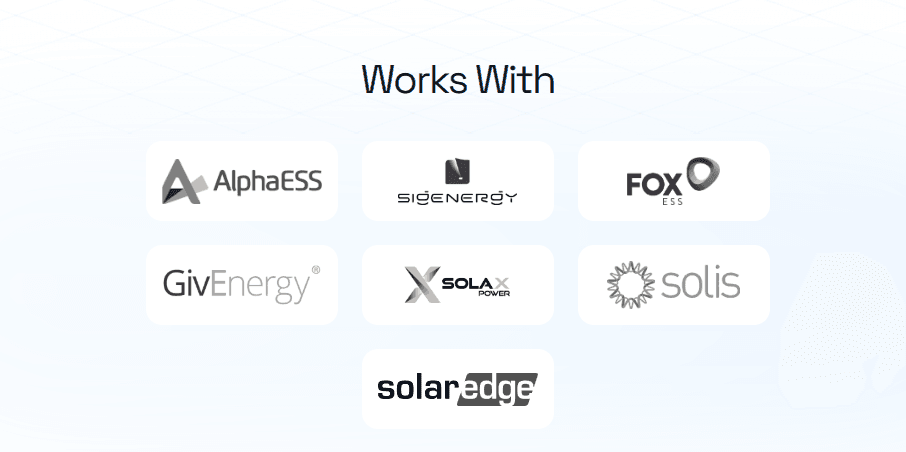
As of September 2026 the supported brands are AlphaESS, Sigenergy, FoxESS, GivEnergy, SolaX Power, Solis and SolarEdge. Mine is FoxESS and it connected without any local configuration at all.
If your brand is not on that list there is nothing to be done for now except ask them to add it, which Axle invites you to do from their own site. Check this before you get attached to the numbers further down the page.
GivEnergy owners get Premium included
This one is worth money on its own and is easy to miss. If you have a GivEnergy battery, your GivEnergy Premium subscription is included as part of joining Axle. They cover the cost on your behalf, so you do not need to subscribe separately and you will not be charged for it. If you are already paying for Premium, you can cancel that subscription once Axle is connected.
If Premium is not showing on your GivEnergy account, or you are still being prompted to pay for it, the usual fix is to reconnect the device. Log in to your Axle account, go to Account, then Devices, then Select Reconnect Device. That restores Premium access straight away in most cases.
If it is still missing after reconnecting, check that you are registered as the system owner on your GivEnergy account rather than a delegate user. Some installers set customers up as delegates, and a delegate account cannot be connected to third-party programmes like Axle. Your installer has to change you to system owner, after which Premium should pull through once you reconnect the device. If it still will not appear, Axle's support can look into it directly.
The trade-off is the one mentioned earlier: GivEnergy customers are not eligible for Axle's referral rewards, so you will not get the £25 sign-up credit that everyone else does. You get the Premium subscription covered instead. Whether that is the better end of the deal depends on what Premium costs you today.
I am on FoxESS so neither of these applies to me, but if you are weighing Axle against doing nothing and you own a GivEnergy system, a free Premium subscription is a real part of the answer.
Getting paid twice for the same kilowatt-hour
This is the part that took me a while to believe. The energy your battery sends during an Axle event still goes out through your export meter, so Octopus still settles it on Agile like any other exported unit. Axle pays its £1 per kWh separately, into an Axle balance. Nothing is deducted and no election has to be made. Axle is explicit that the programme works alongside any supplier, tariff or feed-in arrangement.
Put those numbers next to each other. Across the evening of 20 September and the following morning my Agile export price ran between about 15p and 21p, with the best half-hour of the lot at 20.85p. A kWh sent during an Axle event pays £1.00 from Axle on top of whatever Agile happens to be paying at the time, and grid stress tends to coincide with high wholesale prices, so the Agile side is usually towards the upper end when an event fires. Roughly five times the best slot of the day, and you keep the best slot of the day as well.
They arrive in two different places, which is worth knowing before you go looking. The Agile side appears in your normal Octopus export credit. The £1 per kWh appears as a transaction in the Axle app that you withdraw when you want it.
What it has actually paid me
No projections, no modelled annual figures. This is the account as it stands on 20 September 2026, seven weeks after signing up at the beginning of August.
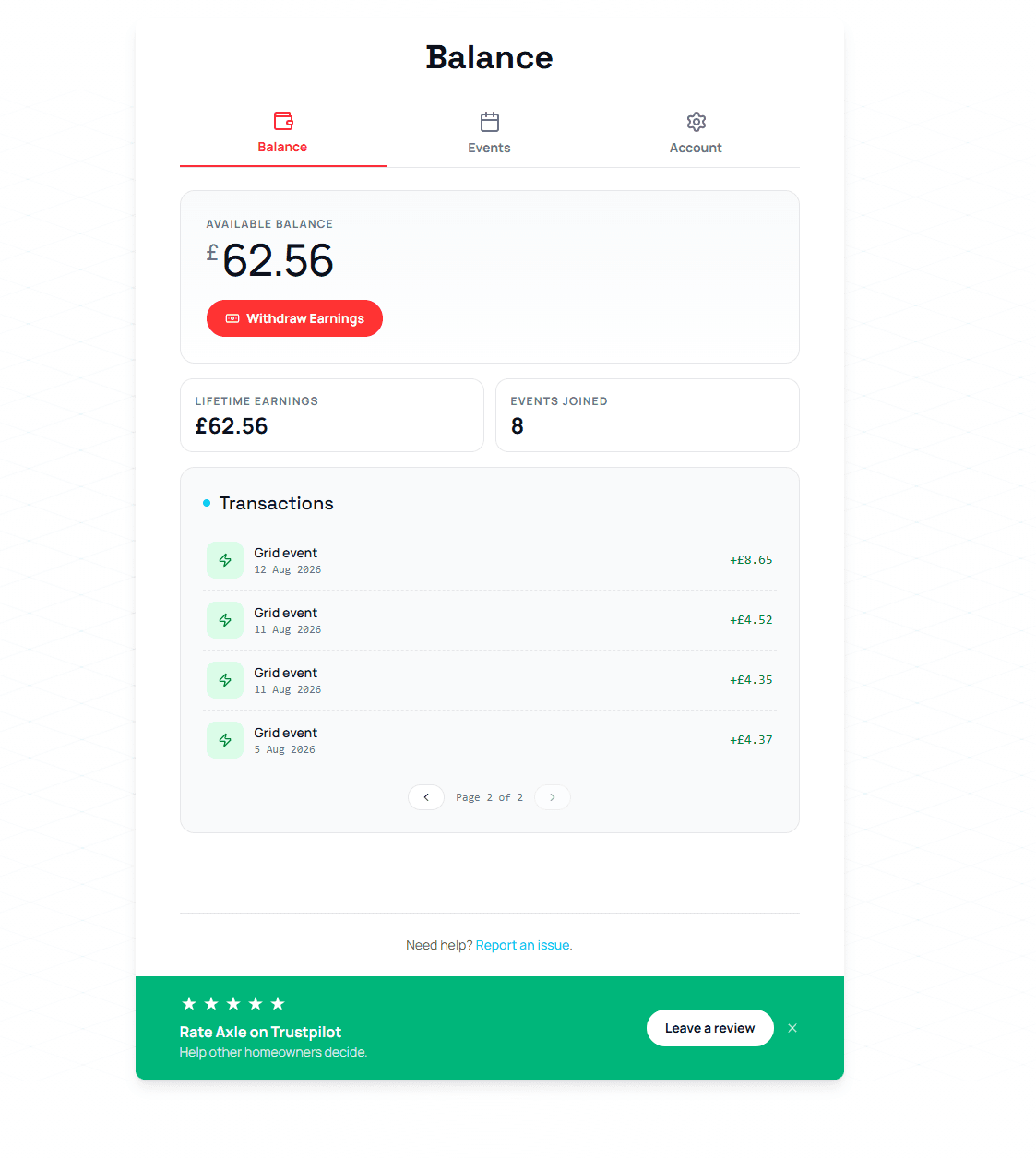
August: five grid events on the 5th, 11th, 11th again, 12th and 17th, paying £4.37, £4.35, £4.52, £8.65 and £4.56. That is £26.45 for a first part-month.
September to the 13th: three grid events paying £3.78, £3.11 and £4.22, so £11.11. Then a £25.00 referrer bonus landed on the 17th for one person signing up through my link.
Eight events, £37.56 of grid earnings, £25.00 of referral bonus, £62.56 in the balance. Lifetime earnings and available balance are the same number because I have not withdrawn any of it yet.
The August ledger
The second page of transactions is the first full stretch after signing up, and it is the more useful one for anyone trying to judge what a normal month looks like. Five events in twelve days from the 5th to the 17th, then a quieter end to the month.
The 12 August event is the outlier at £8.65. Everything else sat between £4.35 and £4.56, which is the pattern I have come to expect: a handful of events a month, each one worth roughly the price of a coffee, occasionally one worth two.
Why the £10 a month guarantee is the real story
Axle guarantees a minimum of £10 a month, on every dispatch mode. In my two months it has not had to pay out, because August cleared £26.45 and September had passed £11 before the middle of the month. On the surface that makes the guarantee look irrelevant. It is the opposite.
The guarantee is what turns this from a bet into a floor. Events are not evenly spread. They depend on how tight the national system is, which is weather and demand and what the rest of the generation fleet is doing, none of which you control. Some months will be thin. The guarantee means a thin month still pays £10 for a battery that was going to sit there anyway.
It matters most exactly when the volume earnings are weakest. In deep winter the house is dark and expensive and the battery is fully committed to covering your own evening peak, so there is less spare capacity to dispatch and fewer easy kWh to sell. That is the point at which a floor is worth more than a headline rate, and it is the reason I would tell someone to sign up in November rather than wait for spring.
One honest caveat. Axle describes the programme as a beta that is subject to change, so the guarantee is a current term rather than a contractual promise for the next decade. Read their terms rather than taking my word for the number.
What I would check before you sign up
Check your battery brand is on the supported list first: AlphaESS, Sigenergy, FoxESS, GivEnergy, SolaX Power, Solis or SolarEdge. Everything else is academic if the integration does not exist yet.
Check you have a smart meter they can read. Axle verifies this during signup, and without half-hourly export data there is nothing to pay you on.
Check you are the registered system owner on your manufacturer account rather than a delegate user. This trips up GivEnergy owners in particular, and it is a change only your installer can make.
Pick your dispatch mode deliberately rather than accepting the default, and turn on short notice events while you are in there. If you run your own scheduling, Events Only or Self Dispatch will keep your plan intact.
Finally, treat everything above as one household's experience rather than a forecast. My roof, my usage and my tariff are not yours, the event count varies month to month, and the beta terms can move. It is not financial advice.
Put your battery to work
This is my referral link. Axle pays £25 each to you and me when you join, so going to axle.energy directly costs you that £25. GivEnergy customers are not eligible for referral rewards.